

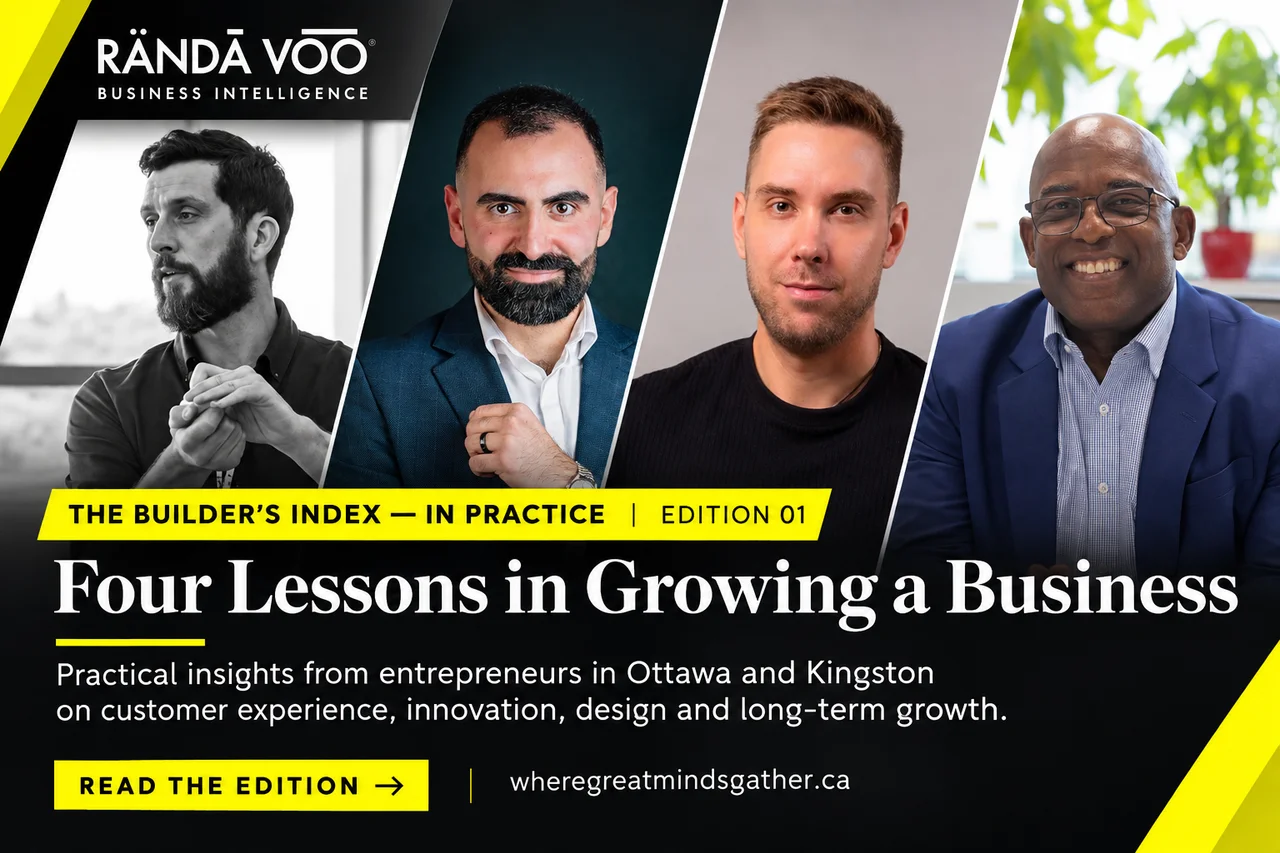
THE BUILDER’S INDEX — IN PRACTICE · EDITION 01
RÄNDĀ VO͞O Business Intelligence
Four entrepreneurs. Two Ontario cities. Four industries. One common challenge: making better decisions as a business grows.
From customer experience and innovation to commercial design and long-term investment, business leaders face decisions that shape how their companies operate, compete and create value.
Through RÄNDĀ VO͞O's Ottawa-based Business Intelligence platform, we've been exploring these decisions with entrepreneurs and professionals building businesses in Ottawa and Kingston.
In this first edition of The Builder’s Index — In Practice, we revisit four original conversations with Mike George, Ali Zaydan, Jesse Arnold and Chris Brown. Their experiences reveal how familiar business concepts translate into practical choices—and what other owners can learn from them.
Four lessons worth carrying forward
Each lesson connects to terminology explained in The Builder’s Index, RÄNDĀ VO͞O's independent resource featuring 108 business concepts and practical applications.
01 | Mike George — Make Customer Experience a Growth Strategy
Founder, Aurelius Fine Oils & Balsamic Vinegars
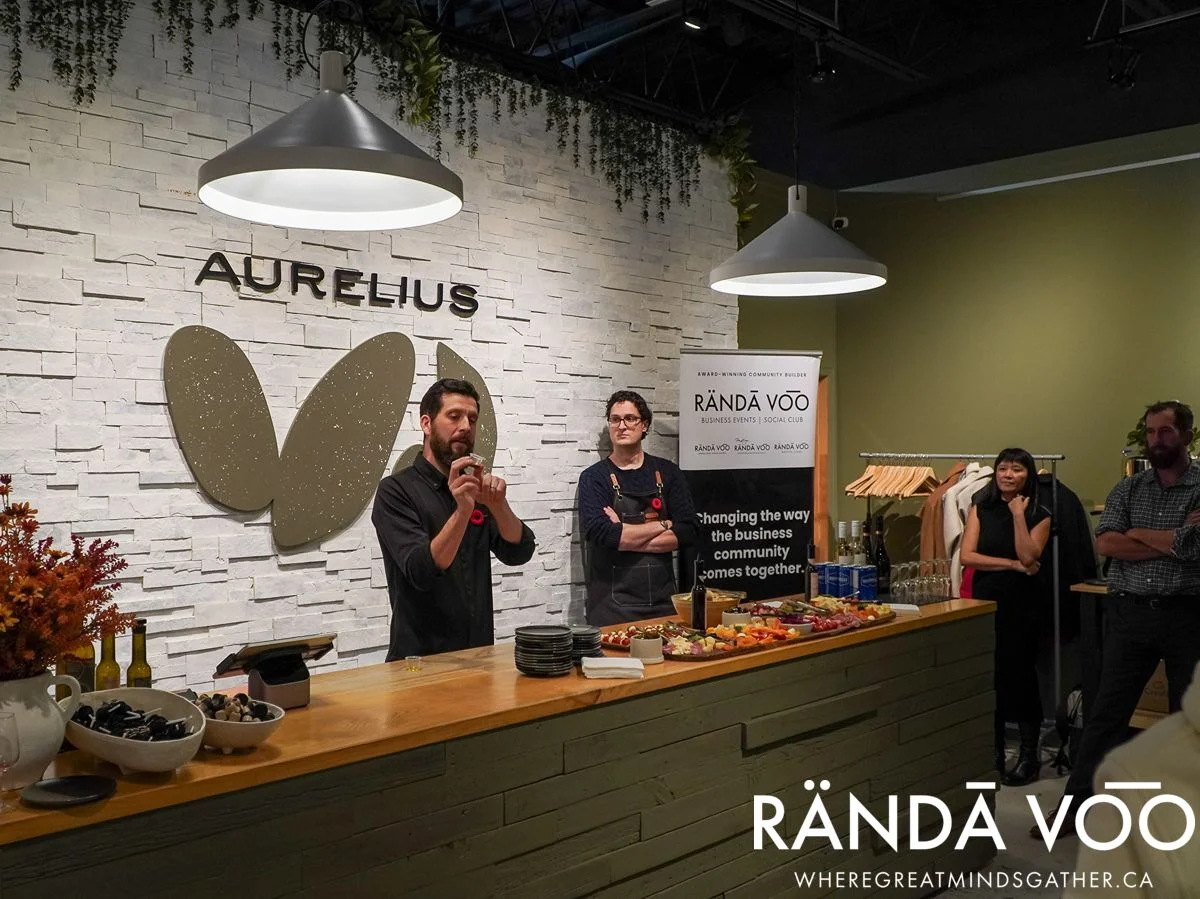
What makes a customer choose one business over another when similar products are readily available?
At Aurelius, Mike George has built a business around helping customers experience the answer.
Visitors to the company's Ottawa boutiques can sample approximately 45 olive oils and balsamics, discover pairings and receive guidance from staff Mike calls tasting guides rather than sales associates.
That distinction is deliberate. Instead of relying entirely on product descriptions, Aurelius creates opportunities for customers to discover quality through direct experience.
The model has expanded from its Wellington West beginnings to three Ottawa boutiques, including the Glebe and Kanata.
But expansion introduced a different business challenge: maintaining the customer experience without the founder being present for every interaction.
Mike's approach increasingly depends on developing employees, establishing consistent standards and creating an environment where staff can exercise good judgment.
As he explains:
“Bigger only counts if we’re getting better at the same time.” — Mike George
The commercial value extends beyond an individual purchase.
Mike describes how an existing professional relationship developed into recurring orders from a realtor purchasing gifts for approximately 150 VIP clients. That opportunity illustrates how trust and a memorable customer experience can create business beyond the original transaction.
It also offers a practical way to think about customer lifetime value: a relationship's potential economic contribution over time, rather than the revenue generated by one visit.
The business lesson
Growth should strengthen the experience customers value, not dilute it. Businesses that can deliver their standards consistently are better positioned to expand without making every interaction dependent on the founder.
Put it into practice: What part of your customer experience currently depends on you? What systems, training or decisions would help your team deliver that experience consistently?
Explore the business concepts: Value Proposition · Customer Lifetime Value (LTV / CLV) · Scale-Up
02 | Ali Zaydan — Solve the Problem, Not Just the Process
Co-Founder & CEO, Drivisa

Innovation doesn't always mean creating something entirely new. Sometimes it means questioning why an established service still operates the way it does.
Ali Zaydan recognized that driver education remained dependent on fragmented administrative processes.
Students and instructors were spending time managing paperwork, phone calls, scheduling and coordination—activities that complicated the experience of accessing and delivering instruction.
Through Drivisa, Ali and his team set out to reduce that friction.
His perspective draws an important distinction between digitizing an existing process and genuinely improving it.
As Ali puts it:
“Innovators question everything.” — Ali Zaydan
Putting paperwork online may make a process more convenient. But if the paperwork itself is unnecessary, a more valuable innovation may involve eliminating the requirement altogether.
That distinction is relevant well beyond technology businesses.
Professional-services firms, retailers, hospitality operators and established companies can all become accustomed to processes that exist primarily because they've always existed.
For Drivisa, technology supports the operation, but the underlying business remains driver education. Ali is careful not to confuse the platform delivering the service with the customer need being served.
His experience also illustrates what happens when growth accelerates.
More customers can expose operational weaknesses, dependencies on outside providers and systems that were not designed for greater volume. Those challenges create decisions about where to invest, what to automate and which capabilities to develop internally.
The business lesson
Innovation creates value when it solves a meaningful customer problem. Technology is useful when it reduces friction, improves delivery or enables a better experience—not merely because a process has become digital.
Put it into practice: Identify a process your customers regularly find frustrating. Does it need improvement, automation or elimination? What evidence would help you decide?
Explore the business concepts: Problem Discovery · Innovation · Market Development
Read Ali's full Builder Profile — Growth, Discipline and Reinventing Driver Education
03 | Jesse Arnold — Every Investment Should Have a Purpose
Owner & Principal Designer, Inicio Design

A commercial space can look impressive and still fail the business operating inside it.
For Jesse Arnold, owner and principal designer of Ottawa-based Inicio Design, effective commercial design begins with understanding what the space must accomplish.
Customer movement, employee workflow, lighting, acoustics, operating requirements and budgets all influence the decisions that follow.
His approach challenges business owners to look beyond visual appeal and consider how an environment supports everyday performance.
As Jesse explains:
“There’s no point creating something that looks fantastic if it doesn’t function for the people using it.” — Jesse Arnold
That philosophy is visible in his work with commercial clients, including recognizable retail names such as Farm Boy and Quickie.
Inicio Design's Farm Boy Collingwood project also received a 2026 Silver Certification from the GRANDS PRIX DU DESIGN awards.
But the broader business lesson isn't simply about award-winning design.
Jesse emphasizes understanding where a project genuinely benefits from investment and where more resourceful choices can achieve the same functional result.
Lighting and acoustics, for example, may contribute more to a customer's everyday experience than an expensive decorative feature. Materials and finishes can sometimes provide flexibility when project budgets become constrained.
These are business trade-offs.
Every organization operates with finite resources. Choosing to spend more in one area often means accepting less investment somewhere else.
Jesse's experience also extends beyond designing spaces. Building Inicio Design required developing financial, marketing, scheduling and client relationship capabilities alongside his technical expertise.
Like many founders, he discovered that being good at the work and building a business around that work require different skills.
The business lesson
Investment should follow purpose. The strongest commercial decisions balance appearance, function, customer expectations and financial realities rather than treating each consideration independently.
Put it into practice: Before committing to your next significant business investment, define what success must look like. Which elements directly support that outcome, and which could be simplified without compromising the result?
Explore the business concepts: Trade-Off · Creating Value · Investment
Read Jesse's full Builder Profile — Every Square Foot Has a Job
04 | Chris Brown — Build with the Long Game in Mind
Owner & Broker of Record, EXIT Excel Realty

After more than three decades in real estate, Chris Brown has experienced changing markets, economic uncertainty and the consequences of both short-term and long-term investment decisions.
His perspective begins with understanding the purpose behind a decision.
In real estate, that may involve evaluating financing, borrowing costs, rental income, property values and the capacity to manage unexpected setbacks.
A property that appears attractive today may not support the investor's objectives over a longer period.
Chris also cautions against becoming overly influenced by market predictions or national headlines that may not reflect local conditions.
Real estate, in his view, requires understanding the circumstances of the particular market, property and investor.
But one of his strongest business lessons concerns the people around us.
“The quality and character of those you surround yourself with matters far more than the quantity of people hanging around.” — Chris Brown
That observation has significance beyond real estate.
Entrepreneurs depend on accountants, lawyers, bankers, suppliers, employees and professional peers whose advice and judgment can materially influence business decisions.
A large network doesn't automatically provide the right expertise, shared values or trusted relationships.
For Chris, long-term success requires intention, integrity and an understanding of what an investment or professional relationship is meant to accomplish.
His experience reinforces the importance of strategic planning: knowing what you're trying to achieve, evaluating the risks and maintaining the flexibility to respond when circumstances change.
The business lesson
Strong business decisions require more than access to capital or information. They depend on clear objectives, realistic assessments of risk and people whose judgment you trust.
Put it into practice: Consider a significant decision you're currently facing. Are you evaluating it against your long-term objectives? Have you involved the right people, and do you understand the risks if conditions change?
Explore the business concepts: Strategic Plan · Investment · Mutually Beneficial Agreement
Four Industries. A Shared Business Reality.
Specialty retail, technology-enabled services, commercial design and real estate operate under different conditions. Yet the experiences of Mike, Ali, Jesse and Chris reveal a shared challenge: how to turn intentional choices into lasting value.
Mike George's work to make customer experience repeatable and Jesse Arnold's approach to designing for function share a practical principle: the experience must work consistently in the real world, not just look promising on paper. Ali Zaydan approaches the same challenge from another direction—removing unnecessary steps so a service can work better at greater volume. Chris Brown adds the longer horizon: test each opportunity against sound judgment, risk and relationships that support the decision.
Their approaches are not identical, and growth is not automatically progress. Opening another location, entering a new market, renovating a workspace or acquiring an asset can create opportunity, but also cost and risk. The useful common thread is asking better questions before committing the next resources.
Understand the Business Language Behind These Decisions
Terms such as customer lifetime value, market development, trade-off and strategic plan can sound academic when encountered in isolation. Here, they describe business decisions being made every day.
Customer lifetime value encourages owners to think beyond one transaction. Market development describes taking an established offering into new markets. Trade-offs recognize that resources are limited. Strategic planning connects ambitions with priorities, responsibilities and available resources.
That's the purpose of The Builder’s Index — In Practice: connecting the language of business with real experiences from people actively building companies.
Continue Learning. Continue Connecting.
Understand the business concepts. Explore The Builder’s Index for 108 plain-language explanations, practical applications and Canadian business context.
Connect with Ottawa's business community. Explore RÄNDĀ VO͞O Rooms to discover professional experiences designed for meaningful conversation and relationship development.
RÄNDĀ VO͞O — Where Great Minds Gather.
Editorial note: This article draws on previously published RÄNDĀ VO͞O Builder Profiles. Direct quotations are attributed to the featured individuals. The business lessons, interpretations and connections to Builder’s Index terminology are independently developed by RÄNDĀ VO͞O's editorial team. The content is educational and does not constitute individualized business, financial or investment advice.
RELATED INTELLIGENCE
RÄNDĀ VO͞O Editorial Series
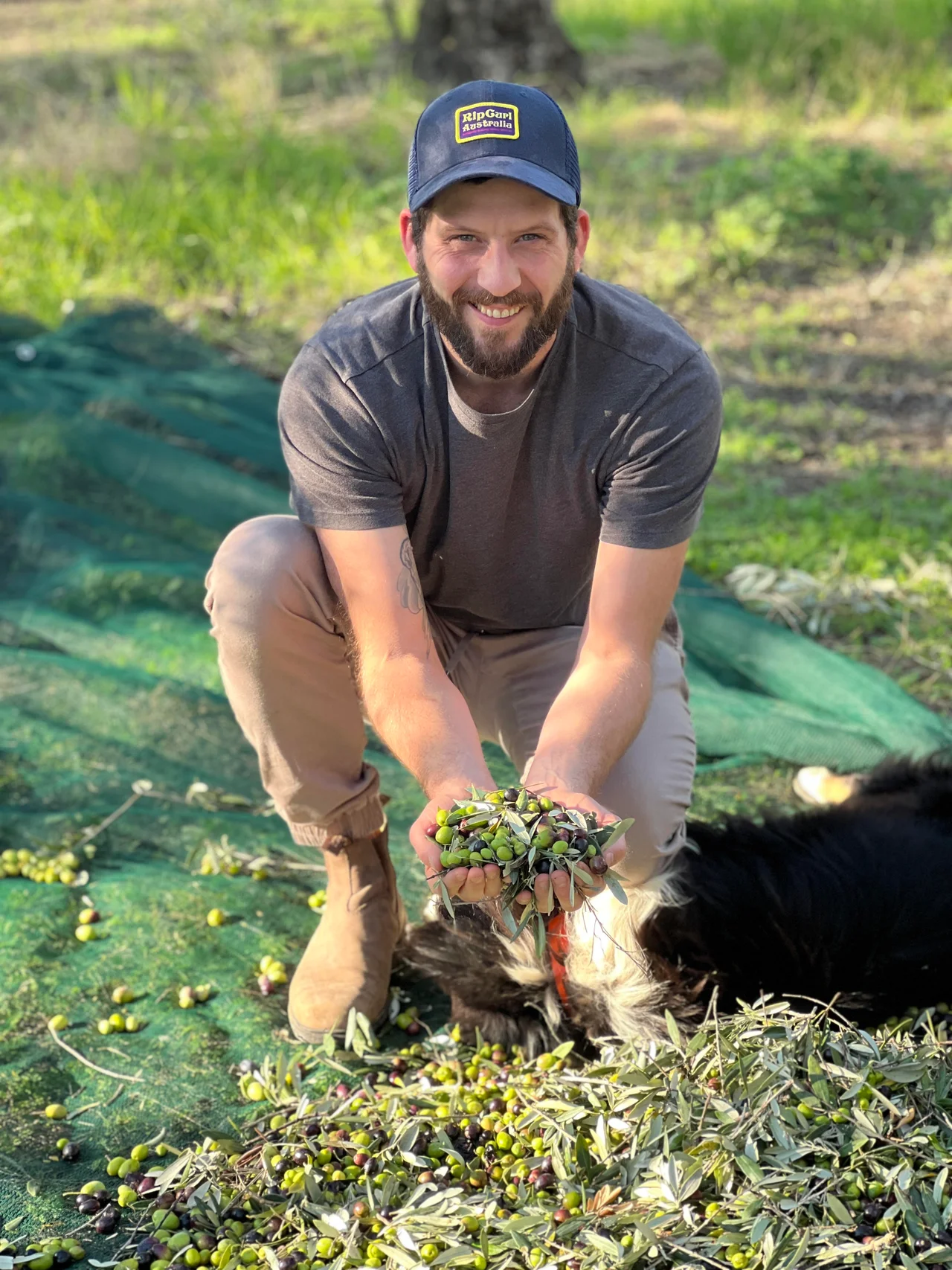
BUILDER PROFILE
Mike George
Founder, Aurelius Fine Oils & Balsamic Vinegars
The Aurelius Standard: Why Customer Experience Is a Growth Strategy
Aurelius founder Mike George shares what customer experience, leadership and lasting relationships can teach business leaders about growth.
RÄNDĀ VO͞O EDITORIAL SERIES

BUILDER PROFILE
Ali Zaydan
Co-Founder & CEO, Drivisa
Ali Zaydan on Growth, Discipline and Reinventing Driver Education
A candid conversation with Drivisa Co-Founder & CEO Ali Zaydan on ambition, customer trust, innovation, scaling a business and building with speed.
RÄNDĀ VO͞O Editorial Series
BUILDER PROFILE
Jesse Arnold
Owner & Principal Designer, Inicio Design
Every Square Foot Has a Job
Great spaces don't just make an impression. They strengthen brands, shape customer experiences and help businesses perform.